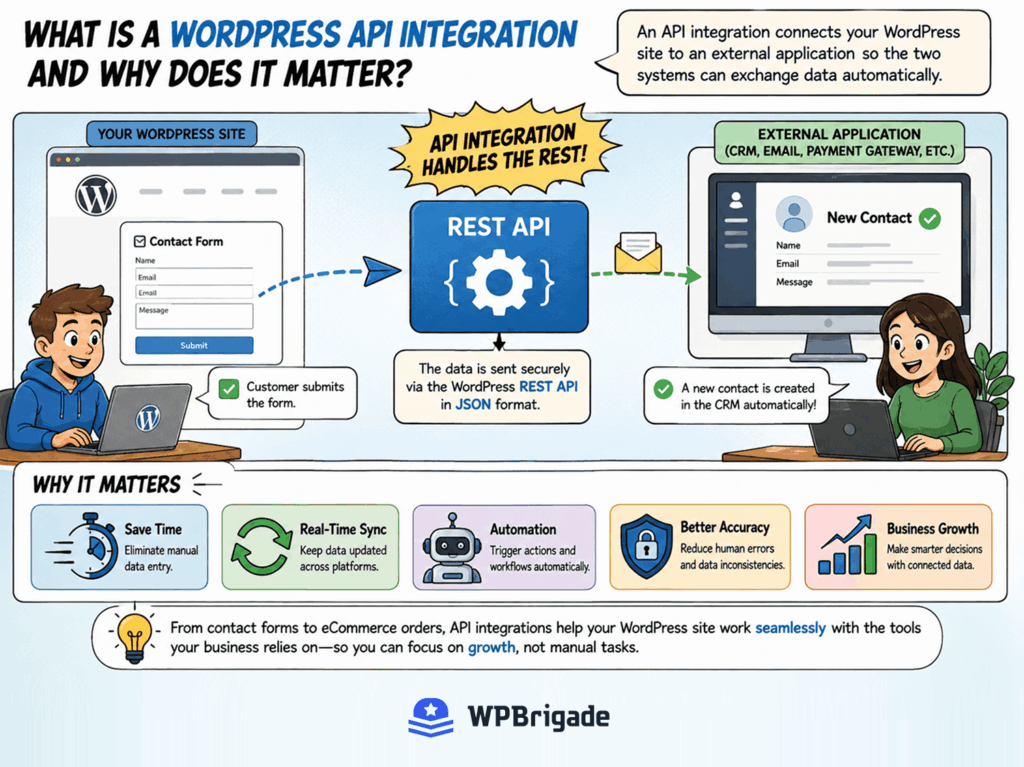
Source: wpbrigade.com
You built the perfect WordPress site. Now you're losing hours every week manually transferring data between your CRM, email platform, and content calendar. The solution should be simple—connect them with an API. But how much will that actually cost you?
If you're an AI user, copywriter, or designer who relies on WordPress as your central hub this question matters. Every dollar you spend on integration is a dollar you're not investing in creative work. But every hour you waste on manual transfer is also costing you money.
This guide breaks down the WordPress API integration cost with real numbers, honest comparisons, and practical advice for 2025. We'll explore what factors influence pricing, how to choose the right WordPress API developer, and when a custom API integration WordPress project is worth the investment. By the end, you'll have a clear price range for your project, understand WordPress API timelines, and know exactly what questions to ask before hiring any developer.
What Is WordPress API Integration and Why Should You Care?
WordPress API integration connects your WordPress site to external applications, services, or databases using Application Programming Interfaces (APIs). In plain terms, it how your website "talks" to other tools—enabling seamless automation, real-time data synchronization, and streamlined workflows across your entire technology stack.
The WordPress REST API, for instance, lets developers create, read, update, and delete content programmatically. A WordPress API project might involve:
- Connecting WooCommerce to your ERP system so inventory updates automatically
- Syncing form submissions to your CRM without manual
- Enabling an AI writing tool to publish drafts directly to your blog
- Pulling design assets and client feedback into WordPress templates
For AI users**, this means automating the entire content pipeline—from ideation to publication—without copy-pasting between platforms. WordPress development for AI integrations is one of the fastest-growing segments in 2025.
For copywriters, it means syncing client brief, approvals, and deliverables between WordPress and your project management tools. No more "did you get my email?" conversations.
For designers, means pulling brand guidelines, assets, and feedback from external libraries straight into your templates. Everything stays current, automatically.
Without integration, these workflows fragmented. You lose time, make errors, and create bottlenecks that frustrate clients and eat into profit margins. Understanding the WordPress API integration cost upfront helps you budget effectively and prioritize which connections deliver the highest return on investment.
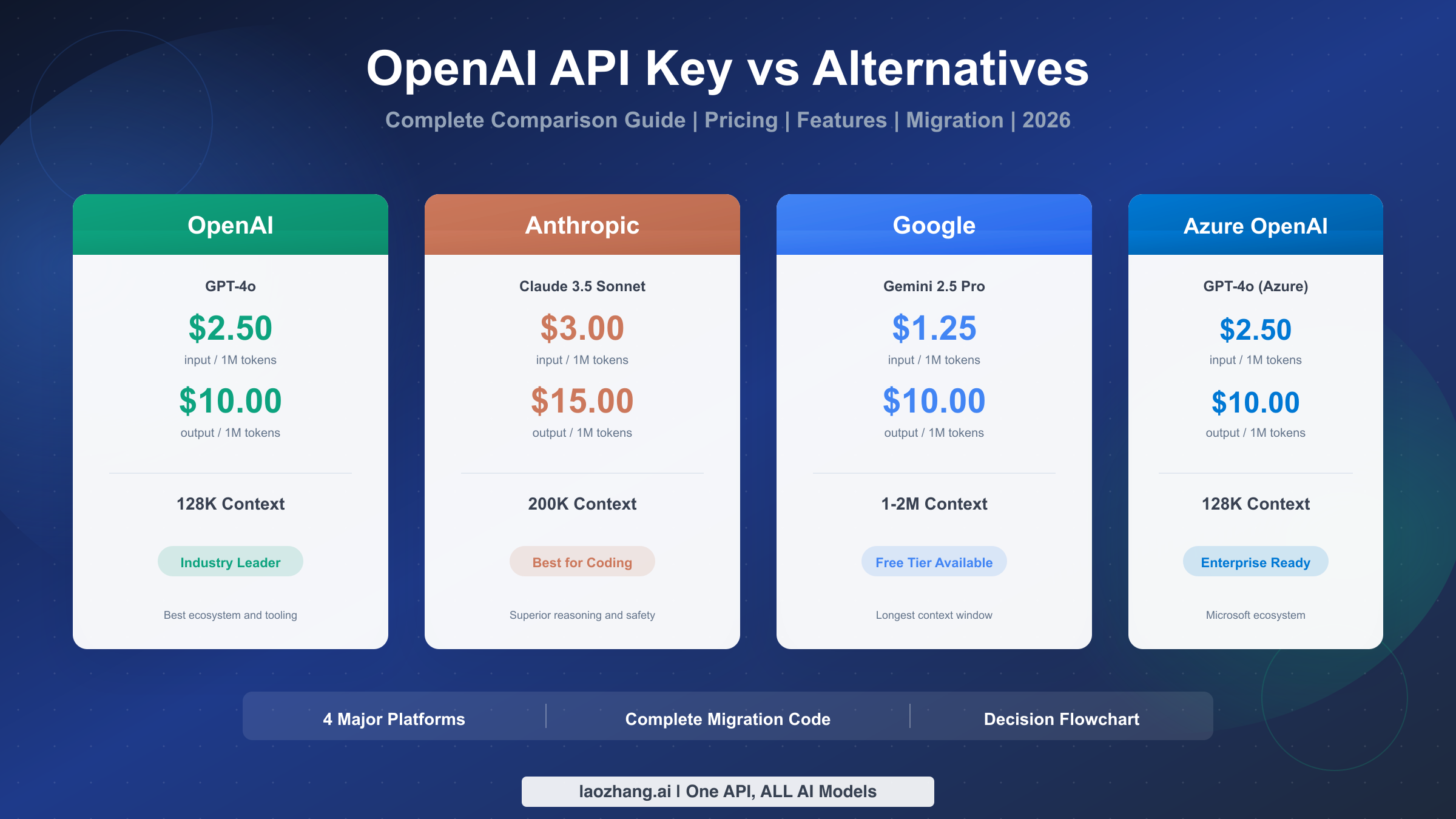
Source: www.aifreeapi.com
7 Key Factors That Influence WordPress API Cost
No two integration projects cost the same. Professional developers evaluate these variables during the scoping phase before quoting a price. Understanding them helps budget realistically and avoid surprises when hiring a WordPress API developer.
Source: www.linkedin.com

1. Complexity of the Integration
A basic integration—like connecting a contact form to a single email service—requires minimal effort. A complex one involving bidirectional data sync, real-time updates, error handling, and multiple endpoints costs substantially more.
Think of it like plumbing: connecting one sink to a water supply is straightforward. Rerouting the entire building water system with sensors and backup valves? That's a different project entirely.
2. Number of APIs and Endpoints
Every external system you connect adds to the workload. Integrating one API with three endpoints is far simpler than connecting three APIs with fifteen endpoints. Each requires:
- setup
- Data mapping
- Testing
- Documentation
More endpoints mean more potential failure points and more development hours—directly impacting your WordPress API development cost.
3. Authentication and Security Requirements
OAuth 2.0, API keys, JWT tokens and custom headers all add layers of complexity. A developer must implement these correctly to protect sensitive customer data.
If you handle financial, healthcare, or confidential client information, higher security requirements will increase your WordPress API integration cost. This is non-negotiable—a data breach costs far more than robust security implementation.
4. Data Mapping and Transformation
Here's a frustrating reality: APIs rarely share identical data structures. Your WordPress site might store a customer name in one field, while your CRM expects it in another format. Data mapping—transforming and formatting data systems—can consume a significant portion of development time.
This is especially true with:
- Large datasets
- Custom post types
- Complex relationships
5. Custom vs. Pre-Built Solutions
Pre-built plugins exist for common integrations, but they often sacrifice flexibility. A custom API integration WordPress project tailors every aspect to your specific workflow.
Yes, this costs more upfront. But it eliminates the workounds, plugin conflicts, and feature limitations that plague generic solutions. Many businesses find custom integrations save money in the long run reducing friction and maintenance headaches. When evaluating WordPress API integration cost, consider the total cost of ownership— just the initial price tag.
6 Developer Experience and Location
Rates for a WordPress API developer vary dramatically based on expertise and geography:
- Junior freelancers:20–$40 per hour
- Experienced freelancers: $50–$100 per hour
- Senior developers: $100–$200+ per hour
Location matters too. Developers in North America and Western Europe command higher rates than those in Eastern Europe, Asia, or South America—though quality can be comparable. The is finding someone with specific WordPress and API experience, not just general coding skills.
7. Ongoing Maintenance and Support
Here's something many businesses overlook: API integrations are not "set and forget." External APIs change their endpoints and authentication methods. WordPress releases updates. Your business requirements evolve.
Budget for:
- Ongoing monitoring
- Bug fixes
- Version updates
- Security patches
Many WordPress API developer professionals offer monthly retainers specifically for this purpose. Skipping maintenance is like never changing your car's—it works until it doesn't, and then you're facing an expensive repair.
Pricing Models for API Integration
When you request for WordPress API development, you'll encounter three primary pricing models. Each has advantages and risks. Here's an honest comparison:
| Pricing Model | Description | Best For | Typical Cost Range |
|---|---|---|---|
| Fixed Price | A single for a fully scoped project. Upfront cost is known, but scope changes incur extra fees. | Well-defined integrations with clear requirements | 500 – $10,000+ |
| Hourly Rate | Pay for actual development time. Ideal for evolving requirements, but total cost is less predictable. | Complex or exploratory projects | $25 – $200 per hour |
| Monthly Retainer | Ongoing support,, and iterative improvements for a fixed monthly fee. | Businesses needing continuous integration support | $300 – $2,000 per month |
** tip:** Most businesses benefit from a hybrid approach—a fixed price for the initial build plus a smaller retainer for ongoing maintenance. When comparingWordPress API integration cost** estimates, be wary of extremely low fixed quotes. They often indicate skipped security, poor documentation, or hidden charges appear later.
Cost Breakdown by Integration Type
Different integration types carry different complexity levels. Here's what you can expect to pay for WordPress API integration categories in 2025:
Standard REST API Development
WordPress has a built-in REST API, but custom endpoints are needed to expose specific data or accept custom actions. A WordPress API development project focused on endpoints might include:
- A headless setup
- A mobile app backend
- External content consumption
Estimated cost: $800 – $5,000 depending on the number of endpoints and authentication methods.
CRM Integration
Syncing WordPress form submissions, WooCommerce orders, or user registrations with a CRM like, HubSpot, or Zoho is one of the most common requests. This usually requires:
- Mapping custom fields
- Handling duplicate records
- Ensuring real-time or scheduled syncs
Estimated cost: $1,000 – $7,500. The price varies based on your's API complexity and data volume.
ERP Integration
Connecting WooCommerce or a custom site to an ERP system (SAP, NetSuite, Odoo, Microsoft Dynamics) is inherently complex. ERPs manage inventory, accounting, shipping, and procurement—each requiring specialized data and often batch processing.
This is high-stakes work where errors can disrupt your entire operation. A skilled WordPress API developer with enterprise experience is essential.
Estimated cost: $3,000 – $20,000+. Because ERPs are mission-critical, you need an experienced professional who understands both WordPress and enterprise systems.
AI and Automation Tool Integration
For AI users, connecting WordPress to tools like OpenAI,, or custom machine learning models is increasingly popular. Whether you want AI-generated content drafts pushed to WordPress or automated tagging and categorization, these integrations:
- Careful prompt engineering
- API key management
- Output sanitization
Estimated cost: $1,500 – $8,000. Since AI tools evolve rapidly, budget for periodic updates—your WordPress API cost should include ongoing maintenance for these dynamic systems---
Hiring a WordPress API Developer vs. DIY
Some WordPress users consider building an API integration themselves using plugins or no-code tools. It cheaper upfront. But the comparison below reveals why hiring a professional WordPress API developer often wins:
| Criteria | DIY / Plugin Approach Hiring a Professional WordPress API Developer |
|----------|----------------------|-----------------------------------------------|
| Cost | Low ($0 – $300 for plugins) | Higher ($500 – $20,000+) |
| Customization | Limited to plugin features | Fully tailored to your workflow |
| Security | Depends on plugin quality; often weak | Enterprise-grade authentication and data encryption |
| Reliability | Plugin and update breaks common | Robust error handling and logging |
| Long-Term Scalability | Outgrows quickly | Built to scale with your business |
| Time Investment | Hours of trial and error |; developer handles end-to-end |
Key takeaway: DIY integration saves money today but costs significantly more in lost productivity, security breaches, rework. For AI users, copywriters, and designers who rely on WordPress daily, a broken integration means missed deadlines and frustrated clients. Hiring a professional is an investment in reliability—not an expense. When calculating WordPress API cost, factor in the true cost of your time potential revenue loss.
Freelancer vs. Agency vs. In-House WordPress API Developer
Once you decide to hire help, you must choose between three sourcing options. Each has distinct cost implications and trade-offs.
Freelance WordPress API Developer
Freelancers offer lowest hourly rates and greatest flexibility. A skilled freelancer can handle most standard integrations. However, you bear the risk of:
- Availability issues
- Single points of failure
- Inconsistent quality across projects
If your project requires multiple integrations or ongoing support, a single freelancer may become a bottleneck. For a custom API integration WordPress project with clear scope, a freelance expert can be an excellent value.
Typical: $25 – $100 per hour. Total project cost for a standard integration: $800 – $5,.
Specialized Agency
An agency provides a team of developers, project managers, and QA specialists. This is ideal for:
- ERP or CRM integrations
- Multi-system architecture
- Projects requiring strict timelines and security compliance
Agencies charge more per hour but deliver higher reliability and accountability. You paying for redundancy, process, and project management—which matters for complex work.
Typical cost: $100 – $250 per hour or fixed pricing of $5,000 – $25,000+.
In-House Developer
Hiring a full-time developer makes only if you have continuous integration needs—daily new features, multiple ongoing projects, or a product that evolves weekly.
The annual cost of an in-house developer (salary, benefits, training, tools) ranges from $70,000 to $150,000+ in the US For small to medium businesses, outsourcing WordPress API development is far more cost-effective.
WordPress API Integration Cost Estimates for 5
Based on current market data and developer rate surveys, here are realistic budget ranges for common projects. These figures assume professional WordPress API development with proper documentation and testing:
- Simple API connection (single form to email/CRM): $500 – $1,500
- Custom WordPress REST API endpoints (3–5 endpoints): $1,500 – $4,000
- WooCommerce to ERP integration: $4,000 – $15,000+
- CRM with bidirectional sync: $2,000 – $7500
- AI content generation and publishing pipeline: $2,000 – $8,000
- Multi-system integration ( + ERP + marketing automation): $8,000 – $25,000
These ranges reflect the WordPress API cost for a completed, tested, and documented solution. Always request a detailed scope of work and breakdown of hours before approving any quote.
How to WordPress API Integration Costs Without Sacrificing Quality
Professional integration is an investment. But you can control costs through smart scoping and preparation.'s how to keep your custom API integration WordPress project within budget:
1. Document Requirements Precisely
Before contacting a developer, write down:
- Every system involved
- The exact data fields to sync
- Trigger events that initiate data transfer
- Desired
Clear requirements reduce discovery time and prevent expensive scope changes. Vague briefs lead to change orders and budget overruns.
. Start with an MVP Integration
Instead of building every feature at once, launch with a minimum viable integration—just the core data flow. Add advanced features later once you've validated the solution in practice.
This approach:
- Lowers initial WordPress API development costs
- Gets you value faster
- Lets you refine requirements based on real usage
3. Use WordPress's Built-in REST API Where Possible
If your needs align with WordPress's native REST API, a developer can often extend it rather than creating everything from scratch. This saves hours and reduces cost significantly.
4. Choose a Developer with WordPress and API Expertise
A specialist WordPress API developer works faster and avoids common. While their hourly rate may be higher, their total project cost is lower because they waste less time debugging. You're paying for experience, just time.
5. Plan for Maintenance from Day One
Unexpected API changes or WordPress updates can break an integration. A small retainer—often $100–$500—prevents costly emergency fixes and keeps your systems running smoothly. Think of it as insurance for digital infrastructure.
Why Professional WordPress API Integration Is a Smart Investment
For AI users, copywriters, and designers, WordPress is not a website—it's a business tool. Every minute spent manually moving data between systems is a minute not spent on creative work. A professionally integration delivers measurable ROI:
- Time savings: Automate repetitive tasks like content publishing, lead capture, and client reporting
- Error reduction: Eliminate manual data entry mistakes that damage client trust
- Scalability: Add new tools and services without rebuilding your entire stack
- Revenue growth: Faster lead follow-up and seamless ecommerce operations directly increase sales
- Security: Protect customer and business data with robust authentication encryption
Consider this real-world example: A copywriter connects WordPress to their CRM and an AI writing assistant. The **custom API integration WordPress project automatically:
- Pulls client briefs from the CRM
- Generates a draft using AI
- Saves it as a WordPress draft for review
That workflow saves hours per week and allows the copywriter to serve more clients. The WordPress API integration cost pays for itself within months—not years.
Frequently Asked Questions About WordPress API Cost
How much does a WordPress API developer per hour?
Most freelance WordPress API developers charge between $25 and $100 per hour. Agencies typically charge $100 to $ per hour. Seniority, location, and project complexity influence rates. Always ask for a portfolio of similar work before hiring.
What is cheapest way to integrate an API with WordPress?
The cheapest approach is using a pre-built plugin if one exists for your specific need. However, often lack customization and may create security vulnerabilities. For reliable, tailored results, a fixed-price custom API integration WordPress project is usually more-effective long-term.
How long does a WordPress API integration take?
A simple integration can be completed in 3–5 days. Complex or multi-system integrations may take 4–12 weeks. The timeline depends on data mapping, testing, and feedback cycles. Rush jobs cost—plan ahead.
Do I need to pay for API maintenance?
Yes. Most integrations require occasional updates when external APIs change or WordPress releases major updates. A small monthly retainer or ad-hoc maintenance plan is recommended. Skipping maintenance leads to broken integrations and emergency fixes that cost more.
Can I integrate AI tools with WordPress using the API?
Absolutely. Many AI tools offer public APIs that can be connected to WordPress to automate creation, image processing, or data analysis. This is a growing area of WordPress API development with high ROI for content-focused businesses.
How do I know if I need a custom integration or a plugin?
If your workflow is standard (e.g., connecting to a popular email marketing platform), a plugin may suffice. If you need specific data mapping, bidirectional sync, or unique automation logic, a **custom API integration WordPress solution is worth the investment.
Conclusion: Make the Right Investment for Your WordPress Workflow
The WordPress API integration cost from a few hundred dollars for a simple connection to tens of thousands for enterprise-grade ERP systems. But the right number for you depends on your needs, workflow complexity, and growth plans.
Here's your decision framework:
Start with your pain point. Which manual task is costing you the most time or causing the most errors?
Define your requirements clearly. Write down exactly what data needs to flow between which systems—and when.
Get multiple quotes. Compare fixed-price proposals from at least three developers or agencies.
Budget maintenance. Include a monthly retainer in your calculations, not just the initial build.
Prioritize reliability over cost. A slightly more expensive integration that works flawlessly is better than a bargain that breaks monthly.
The cost of inaction is also real. Every week you manually transferring data is time you're not spending on creative work, client relationships, or growing your business.
Your next step: Document your integration requirements today. Even if you're not ready to hire, having clear specifications means you'll be prepared to get accurate quotes when you are. investment in planning will save both time and money when you're ready to build.
Have questions about a specific WordPress API integration project? Reach out to a specialist who can provide a detailed scope and accurate quote based on your unique requirements. If you're ready to move forward, hire a developer who understands both WordPress and the broader API landscape—your workflow will thank you.



0 comments:
Post a Comment