Source: www.evismart.com
Introduction: The Cost of Disconnected Systems
Imagine this: It's Monday morning, and your customer service team is fielding complaints about orders that were oversold over the weekend. Your WooCommerce store showed 12 units of a popular product in stock, but your warehouse had only 4. The inventory data never synced between your e-commerce platform and your ERP system, and now you're facing refunds, disappointed customers, and a tarnished reputation.
This scenario plays out daily in businesses that operate with disconnected systems. WooCommerce powers millions of online stores worldwide, while enterprise resource planning (ERP) software handles back-end operations—inventory management, accounting, procurement, and customer relationships. When these two critical platforms fail to communicate, data silos emerge, manual errors multiply, and operational efficiency plummets.
If you're seeking a WooCommerce ERP integration that eliminates these pain points, guide is your roadmap. We'll examine the available methods, evaluate the trade-offs, and provide a practical step-by-step implementation plan. Whether're a business owner evaluating options, a project manager overseeing development, or a professional who relies on accurate e-commerce data, you'll understand exactly integration requires—and when hiring a WooCommerce ERP integration developer makes the most sense.
Source: webkul.com
Understanding WooCommerce ERP Integration
What It Is and Why It Matters
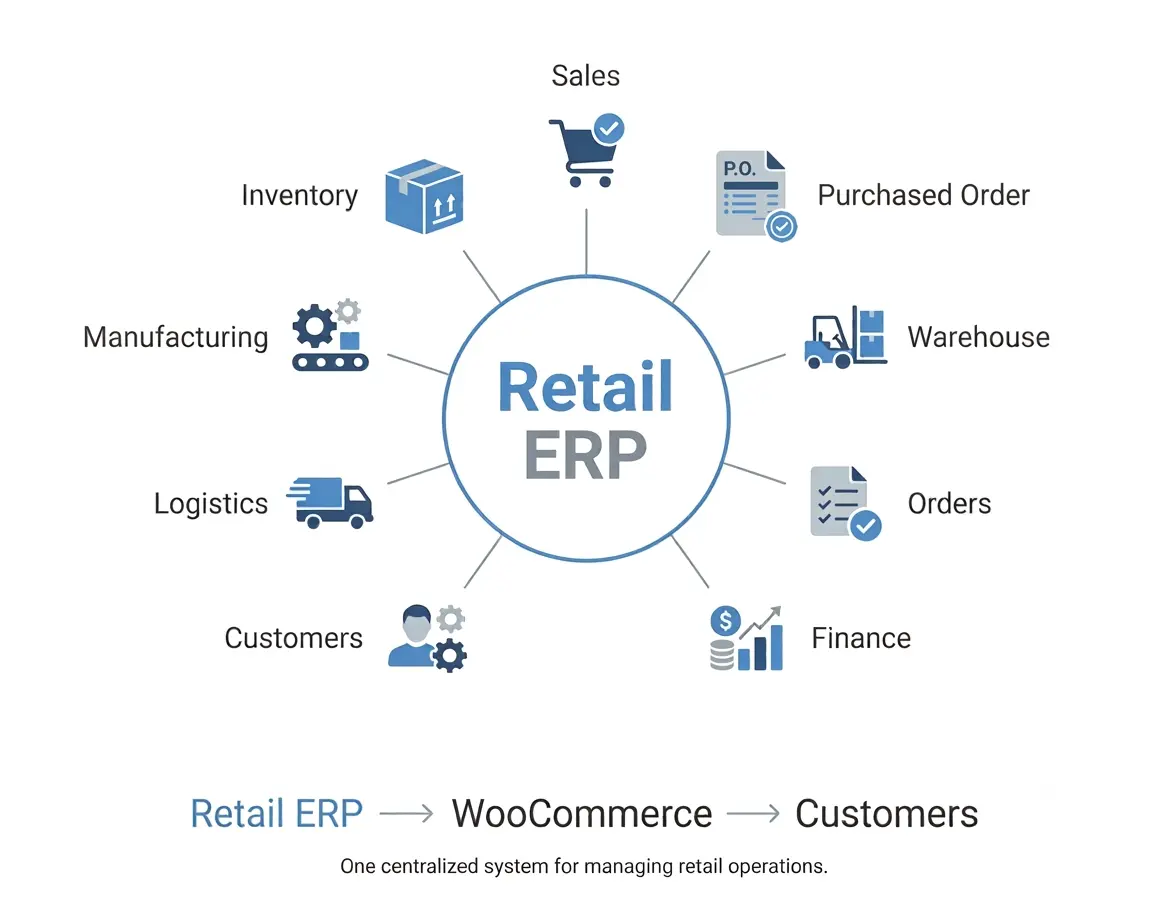
WooCommerce ERP integration connects your online store with your ERP system, enabling seamless data flow the two platforms. Instead of manually copying orders, inventory counts, product details, and customer records from one system to another, an integration creates synchronized environment where both platforms communicate.
The primary data objects exchanged during integration include:
- Product catalogs and attributes
- Inventory levels and stock
- Customer and order data
- Sales orders and invoices
- Shipping and fulfillment updates
- Pricing and tax information
The Business for Integration
The advantages of a well-executed integration extend far beyond convenience:
Real-time inventory visibility prevents overselling and stockouts. When a customer purchases an item, inventory levels update instantly across all channels.
Automated order transfer eliminates repetitive manual data entry, freeing team to focus on higher-value activities.
Accurate financial reporting becomes possible because sales data flows directly into your accounting modules, reducing reconciliation.
Enhanced customer experience results from accurate product availability and order status information across every touchpoint.
This integration matters beyond the IT department.AI and machine learning teams** need clean, structured data to train models and generate accurate demand forecasts. Content strategists require current product and inventory data to write truthful marketing copy. UX designers depend on accurate product catalogs and customer insights to create targeted campaigns and effective interfaces. A robust integration elevates every role that interacts with your store.
The Strategic Foundation
Before committing to an integration project, conduct formal analysis of your current e-commerce and back-office environment. This assessment should evaluate existing workflows, data formats, ERP capabilities, and long-term needs.
Common ERP systems that integrate with WooCommerce include SAP Business One, Oracle NetSuite, Microsoft Dynamics 365, Odoo, Sage, and Acumatica. Each platform presents unique API structures and data requirements that influence your integration strategy.
WooCommerce provides a robust REST that serves as the foundation for any integration. The API exposes endpoints for orders, products, customers, and reports. Using WooCommerce API integration, developers can create bidirectional synchronization or carefully controlled unidirectional flows depending on your business rules. Authentication typically relies on consumer keys and secrets generated the WooCommerce admin panel.
Your analysis must also address the integration's critical success factors: data mapping accuracy, error handling capability, security protocols and the ability to accommodate future changes in either system. Organizations that skip this strategic planning often face cost overruns, data corruption, and failed implementations. A methodical approach dramatically reduces these risks.
Three Integration Approaches Compared
There are three primary methods for connecting WooCommerce with ERP system, each with distinct implications for cost, complexity, and long-term viability.
| Approach | Complexity | Cost | Scalability | Best |
|---|---|---|---|---|
| Manual CSV import/export | Low | Low upfront, high ongoing labor | limited | Very small stores with low order volume |
| Middleware or iPaaS platforms | Moderate | Subscription-based, moderate ongoing | Moderate, by connector features | Businesses needing quick deployment with standard workflows |
| Custom WooCommerce API integration | High | Higher upfront, lower long-term | Excellent, fully tailored | Growing businesses with unique requirements |
Manual Data Transfer: A Short-Term Fix
Manual CSV import/export quickly becomes unsustainable as your business grows. The labor costs of exporting from one system, formatting it, and importing it into another multiply with every additional order, product or customer record. Human error introduces data inconsistencies that cascade throughout your operations.
Middleware Platforms: Convenience with Limitations
Middleware platforms such as Zapier, Make, Celigo, and Boomi offer convenience and faster deployment times. They work well for straightforward workflows and standard data structures However, these platforms often lack the flexibility required for complex ERP integrations. Custom order statuses, multi-warehouse inventory logic, partial refund, and unique tax rules frequently exceed what generic connectors can handle.
Custom Development: Maximum Control
Custom WooCommerce integration through the API delivers the highest level of control. A developer builds exactly what your business requires, handling multi-warehouse inventory, custom order statuses partial refunds, and unique tax rules that off-the-shelf connectors cannot accommodate.
For businesses anticipating growth, a custom WooCommerce API integration almost always represents the superior long-term investment. It eliminates recurring subscription fees, avoids third-party data exposure, and adapts precisely to your operational model.
Why Hiring a Dedicated Developer Matters
Integrating two complex systems is not a trivial task. WooCommerce's API differs significantly from the APIs of SAP, NetSuite, Dynamics 365, and Odoo. Field names, data types, authentication methods, and error responses vary across platforms. A skilled WooCommerce ERP integration developer reduces the likelihood of costly mistakes and accelerates your time-to-market.
What a Professional Developer Brings
A professional developer handles edge cases that generic connectors miss. Consider these scenarios:
- Handling partial refunds require coordinated updates across multiple systems
- Managing backordered items where inventory allocation spans multiple warehouses
- Processing multi-currency transactions with dynamic exchange
- Supporting custom product variations that don't map neatly to standard ERP fields
Attempting to force these scenarios into a pre-built connector can lead to data corruption and lost revenue.
Long-Term Partnership Value
When you hire a dedicated developer, you gain a long-term technical partner rather than a one-time fix. Experienced ERP integration specialists deliver custom WooCommerce integration solutions that are maintainable, secure, and fully documented. This partnership ensures your integration evolves your business.
Step-by-Step Guide to WooCommerce ERP Integration
The following steps outline a formal, repeatable process for implementing a integration. Each is essential for minimizing risk and ensuring data integrity### Step 1: Define Business Requirements and Data Mapping
Begin by documenting every data object that must synchronize between WooCommerce and your ERP. Determine whether each object requires one-way or two-way synchronization:
- **Products typically flow from ERP to WooCommerce
- Orders flow from WooCommerce to ERP
- Inventory levels require bidirectional updates
Create a data mapping table that specifies how each field in WooCommerce corresponds to a field in your ERP. Include rules for data transformation, such as formatting, converting currency, or mapping product categories. This documentation becomes the blueprint for your entire integration project.
Step 2: Choose Your Integration and Partner
Based on your analysis, select the approach that matches your budget, timeline, and technical requirements. For most businesses with unique workflows a custom WooCommerce integration is the recommended path.
This stage requires engaging a qualified developer who understands both WooCommerce's REST API and specific ERP platform. Look for proven experience in PHP, MySQL, WordPress hooks, and ERP API protocols. Review previous work and request references.
may consider professional WordPress API integration services, which cover custom between WooCommerce and third-party systems.
Step 3: Set Up WooCommerce REST API Credentials
In the WordPress admin dashboard:
. Navigate to WooCommerce Settings → Advanced → REST API
2. Create a new API key
3. Assign read and permissions appropriate to your integration scope
4. Copy the generated consumer key and consumer secret
Store these credentials securely, as they grant programmatic to your store data. This step serves as the gateway for any WooCommerce API integration. Your developer will use these credentials to authenticate to your store's API endpoints.
Step 4: Develop the Custom Integration
Using your documented data mapping, your developer will build the layer. This layer may take the form of:
- A standalone application
- A set of serverless functions
- A WordPress plugin
integration should use WooCommerce hooks to receive real-time event notifications for new orders, updated products, or inventory changes. For scheduled large-scale data transfers, batch processing through the REST API often proves more efficient.
A robust custom WooCommerce integration must include:
- Token refresh mechanisms
- Detailed error logging
- Automatic retry logic
- Data transformation rules
Your developer should also implement security best practices, HTTPS connections, OAuth API key authentication, and least-privilege access controls.
Step 5: Test Thoroughly in a Staging Environment
Never deploy an integration directly to production. Instead:
- Use a staging copy of your WooCommerce store
- Set up sandbox version of your ERP
- Test every scenario thoroughly:
- New orders
- Cancelled orders
- Ref
- Stock updates
- Product creation
- Customer registration
Validate that data appears correctly in both systems and that errors are gracefully. Conduct volume tests that simulate high order loads to confirm the integration performs within acceptable time frames and doesn't interfere with store performance.
6: Deploy, Monitor, and Maintain
After successful testing, deploy the integration to your live environment. Monitor initial transactions closely and verify that data flows match expected results. Establish ongoing maintenance procedures for:
- Security patches
- WooCommerce updates
- ERP upgrades
An experienced will provide comprehensive documentation and ongoing support for future changes. If you need a reliable partner for this critical stage, hire us for a seamless, secure, and scalable deployment.
Common Challenges and How to Overcome Them
Even well-planned integrations encounter obstacles. Formal preparation minimizes these risks. Here are common challenges inWooCommerce ERP integration** with practical solutions:
Data Inconsistency
Challenge: Records don't match between systems, creating confusion and errors.
Solution: Use canonical identifiers and a central mapping table to ensure every record matches across systems. Establish data validation rules that flag discrepancies.
Real-Time Sync Failures
Challenge: Webhooks fail or time out, causing data to become stale.
Solution: Implementhook retry logic with exponential backoff to manage temporary outages. Build monitoring that alerts your team when syncs fail.
Security VulnerabilitiesChallenge: Unauthorized access to sensitive business data.
Solution: Enforce HTTPS connections, use OAuth 2.0 or API keys, and restrict permissions to only necessary endpoints. Conduct regular security audits.
Version Compatibility Issues
Challenge: Software updates break the integrationSolution: Keep WooCommerce, WordPress, and ERP software updated. Test upgrades in staging environments before deploying to production.
Performance Bottlen
Challenge: The integration slows down your store or ERP system.
Solution: Use queue systems and batch processing for large data sets to overwhelming either platform. Optimize API calls to minimize load.
Lack of Documentation
Challenge: Future developers can't understand or modify the.
Solution: Insist on complete technical documentation from your developer. This investment ensures future changes remain manageable and reduces dependency on a single individualAddressing challenges proactively ensures your integration remains stable and efficient over time.
Frequently Asked Questions
What is the typical cost of Woo ERP integration?
Costs vary based on the ERP platform, data complexity, and whether you use a pre-built connector or a custom solution. custom WooCommerce integration typically requires a larger upfront investment but delivers lower long-term costs and greater flexibility.
How long does a Woo ERP integration project take?
Most custom integration projects take between two and six weeks. The timeline depends on the number of data objects, the ERP API complexity, and the testing depth required.
Can I use a WordPress plugin instead of a custom API integration?
Some plugins offer pre-built connectors for popular ERP systems. However, these plugins often lack support for custom fields, complex workflows, and unique business rules. A WooCommerce integration built by a developer provides the flexibility that plugins cannot match.
Will I need to update the integration when WooCommerce or ERP updates released?
Yes. Both WooCommerce and ERP platforms release updates that can affect API behavior. Regular maintenance and testing are essential to keep the integration correctly.
Is data secure during WooCommerce ERP integration?
Yes, when proper security measures are followed. Use encrypted connections, secure authentication methods and restricted permissions. A WooCommerce ERP integration developer will implement these safeguards by default.
Conclusion
WooCommerce integration is not a luxury—it is a strategic necessity for growing e-commerce businesses. Through WooCommerce API integration, you can workflows, eliminate manual data entry, and scale operations efficiently.
We've explored three approaches: manual data transfer, middleware platforms, and custom development While pre-built connectors offer convenience for simple scenarios, a custom WooCommerce integration designed by an experienced developer provides the greatest long-term value control. Regardless of your approach, methodical planning, thorough testing, and ongoing maintenance are non-negotiable.
Your next steps should include1. Documenting your business requirements and data mapping needs
2. Evaluating your ERP platform's API capabilities
3.Consulting with integration specialists** about your specific scenario
For WordPress API integration and ERP integration services, explore our Press API Integration service page or our dedicated ERP Integration service.
Ready to transform your store with a secure, scalable solution? Contact us today and let our experts build the integration your business deserves.



0 comments:
Post a Comment